


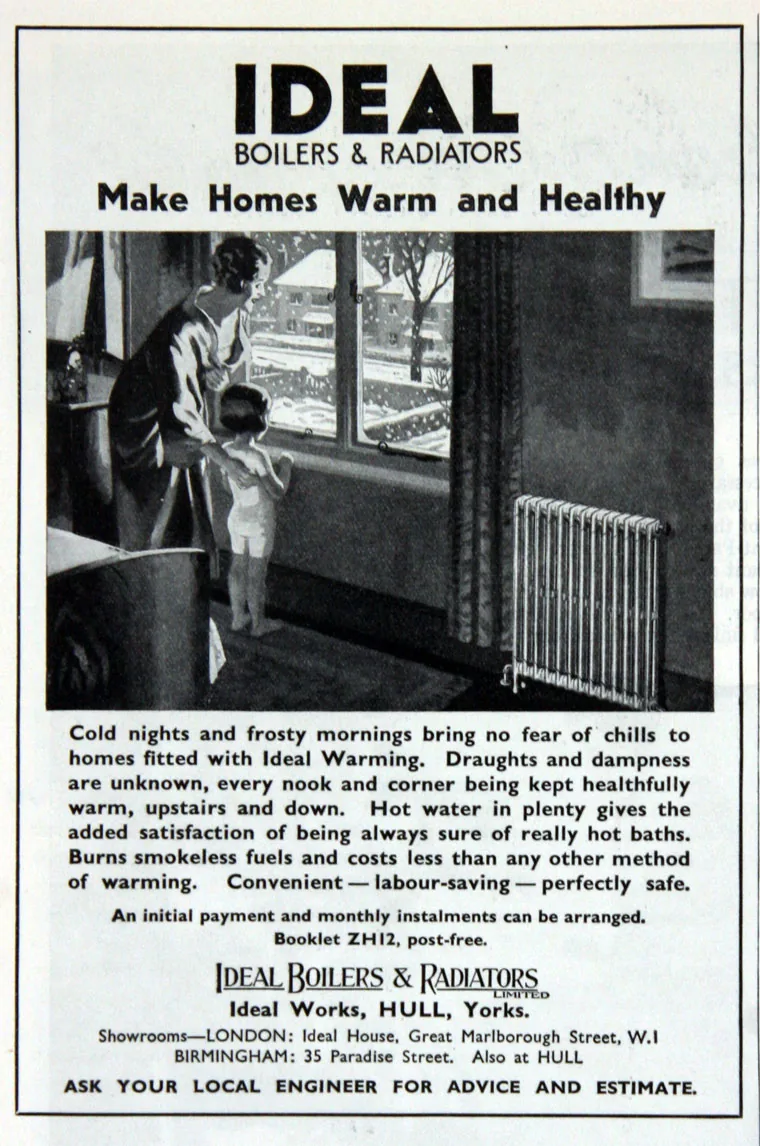
One Hull works, two names — the National Radiator Company, later Ideal Boilers & Radiators · “Make Homes Warm and Healthy”
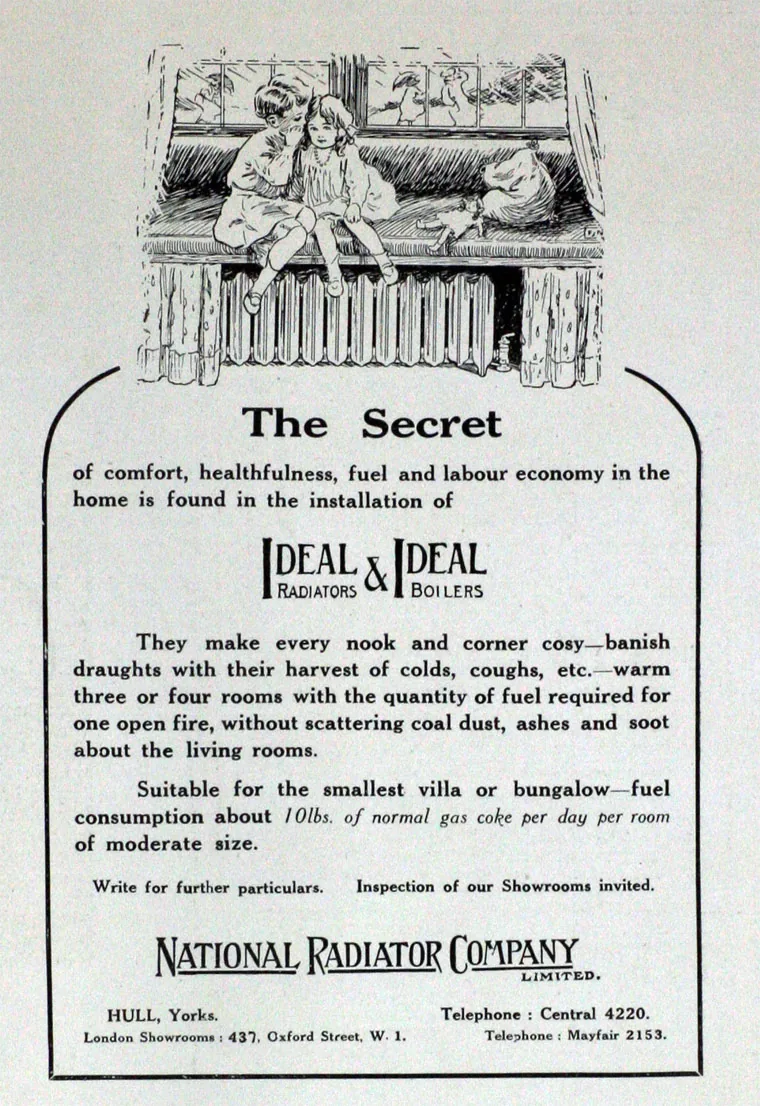
Ideal Standard cast iron radiators were made by the National Radiator Company — the British arm of the American Radiator Company — at its works on National Avenue in Hull, East Yorkshire, from the factory’s opening in 1906 until cast iron radiator production ended in the mid-1970s. The same Hull foundry produced the Neo Classic, the column radiator the reclamation trade describes as the most widespread vintage cast iron radiator in Britain. This page tells the maker’s story, and shows how to recognise a genuine example.
From the American Radiator Company to Hull
The story begins in America. The American Radiator Company (ARCo) was formed in 1892 by the merger of three US radiator makers — the Detroit Radiator Company, the Michigan Radiator & Iron Manufacturing Company and the Pierce Steam Heating Company. Within a few years it was selling into Britain: by 1895 ARCo was trading from a London office and showroom, importing American-made radiators. Demand soon justified a British factory. In 1905 ARCo established its British subsidiary, the National Radiator Company Ltd, and in 1906 built its works in Hull on what became National Avenue.
The Ideal works at Hull
The Hull works cast radiators and boilers under the Ideal brand name, and the reclamation trade knows it best for three radiator models: the Ideal Plain, the Ideal Classic and the Neo Classic. The company grew fast and advertised hard — its 1915 advertising claimed its radiators heated Westminster Abbey — and in October 1926 the Prince of Wales toured the factory. In 1929 the American parent merged with the Standard Sanitary Manufacturing Company to form the American Radiator and Standard Sanitary Corporation, the seed of the Ideal Standard name that came later. In 1934 the business passed to a new public company, Ideal Boilers & Radiators Ltd, and in 1935 the Hull foundry was mechanised — the company described it as the largest mechanised grey iron foundry in England, some 1,000 feet long. During the Second World War the factory turned to munitions, producing around 20 million pieces by the company’s own account; restorers record that, though targeted, the works came through the 1941 Hull Blitz untouched.
The Neo Classic
The reclamation trade dates the Neo Classic to around 1930, following on from the earlier Ideal Classic. Made at Hull in two-, four- and six-column versions, it stayed in production into the early 1970s with barely a design change — restorers call it one of the longest production runs of any cast iron radiator, and describe it as Britain’s most widespread vintage cast iron radiator: the plain-columned workhorse of homes, offices and public buildings across the country.
A note on the name, in the interest of honesty: ‘Neo Classic’ also circulates today as a general style name, used by modern makers selling newly manufactured radiators. The name alone does not make a radiator a Hull original — the castings do, and we cover those below.
The school pattern: hygiene by design
ARCo also originated the plain, flat-fronted pattern Britain came to call the school radiator. Its ancestor, the trade records, is ARCo’s Peerless of the 1890s: in an era of ornate castings it was deliberately smooth and simple, marketed on being easy to keep clean. The idea crossed the Atlantic with ARCo’s British arm, and the trade records that by the early 1930s Ideal Standard and Crane both offered plain, easy-clean institutional patterns in narrow, medium and wide depths — schools and hospitals specified them because flat surfaces left nowhere for dust to hide. For the wider story of how these radiators came to heat Britain, see our history of cast iron radiators.
One thing we say plainly: Neo Classic School and Neo Classic Narrow School are Radrestore’s own range names for school-pattern radiators of this type. The pattern was plain by design, and many sections carry no visible maker’s name — so where blasting reveals a casting mark on a particular radiator, we record it, and where it does not, we describe the radiator by pattern and period rather than guessing at a foundry.
From Ideal Standard to today
By 1948 the business was controlled by the American Radiator & Standard Sanitary Corporation, and in 1953 it took the name Ideal Standard. The Ideal Works at Hull employed around 2,500 people in 1961. Cast iron radiator production there ended in the mid-1970s — sources differ on the exact year — displaced by cheaper pressed steel panel radiators. The name survives twice over: Ideal Heating, part of Groupe Atlantic since 2015, still makes boilers and heat pumps on the same National Avenue site, while the Ideal Standard bathroom brand joined Villeroy & Boch in 2024. Every genuine Ideal cast iron radiator, then, is a Hull casting at least half a century old.
Identifying a genuine Ideal radiator
The reclamation trade records three bush-end marks on radiators from the Hull works:
- A clockwise spiral — a distinctive swirl pattern cast into the bush end.
- The NRC monogram — the letters N, R and C overlapping one another.
- The word IDEAL — found on later castings.
The marks also date a radiator: NRC bush ends point to a casting made before the 1934 change to Ideal Boilers & Radiators, while Ideal-marked ends came after it. One caveat restorers are careful about — bush ends can be swapped between radiators, so they are a guide rather than proof. The surer evidence is cast into the iron itself: the Neo Classic usually carries its name cast into the leg section above the bottom bush. Casting marks read best on bare iron, which is why restoration is the natural moment to check — when a radiator is blasted back to bare metal at the start of our process, every mark the foundry left is briefly as crisp as the day it was cast.
Ideal Standard and Neo Classic radiators at Radrestore
Our restored range includes the Ideal Standard, the Neo Classic, and our Neo Classic School and Neo Classic Narrow School — browse them all on our restored cast iron radiators page. The column patterns are attributed by the reclamation trade to Ideal’s Hull works, and each radiator goes through the full process described on our radiator restoration page — blasted to bare iron, repaired by hand, pressure tested and finished — before it leaves the workshop backed by our 25-year Cast Iron Guarantee. Not sure which pattern suits your building? Call us on 0161 843 8163 or reach us via the Contact page and we will talk it through.
Ideal Standard cast iron radiators: FAQs
Who made Ideal Standard cast iron radiators?
The National Radiator Company, the British subsidiary of the American Radiator Company, established in 1905 with a factory built at Hull in 1906. The business became Ideal Boilers & Radiators in 1934 and Ideal Standard in 1953 — the radiators were cast at the same Hull works throughout.
When did Ideal stop making cast iron radiators?
Cast iron radiator production at the Hull works ended in the mid-1970s — sources differ on the exact year — as cheaper pressed steel panel radiators took over the market. Every genuine Ideal cast iron radiator is therefore at least half a century old.
How can I tell if a radiator is a genuine Ideal or Neo Classic?
The reclamation trade points to the bush ends — a clockwise spiral, an overlapping-letters NRC monogram, or the word IDEAL — and to the Neo Classic’s name, usually cast into the leg section above the bottom bush. NRC marks suggest a casting made before the company’s 1934 name change; Ideal marks came after. Bush ends can be swapped between radiators, so cast-in names are the stronger evidence.
Are Neo Classic radiators still manufactured?
Not by the original maker — production at Hull ended in the mid-1970s. The Neo Classic name does circulate today as a style name used by modern reproduction makers, so a new radiator sold under it is a reproduction, not a Hull original. Radrestore’s Neo Classic range is restored period radiators, not reproductions.
Sources: Grace’s Guide to British Industrial History; Wikipedia (American Radiator Company); Ideal Heating’s published company history; Villeroy & Boch company announcements; and the records of the UK reclamation and salvage trade.