


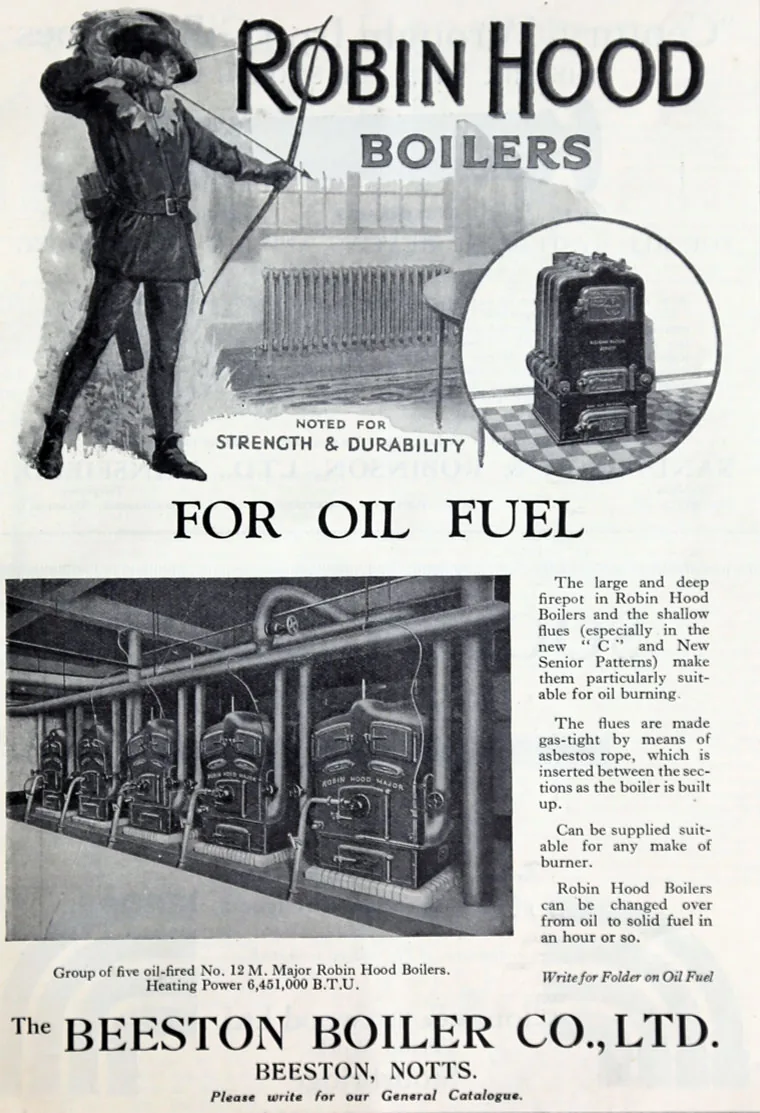
The Beeston Boiler Company, Nottinghamshire · 1893–1976 · “Noted for strength & durability”
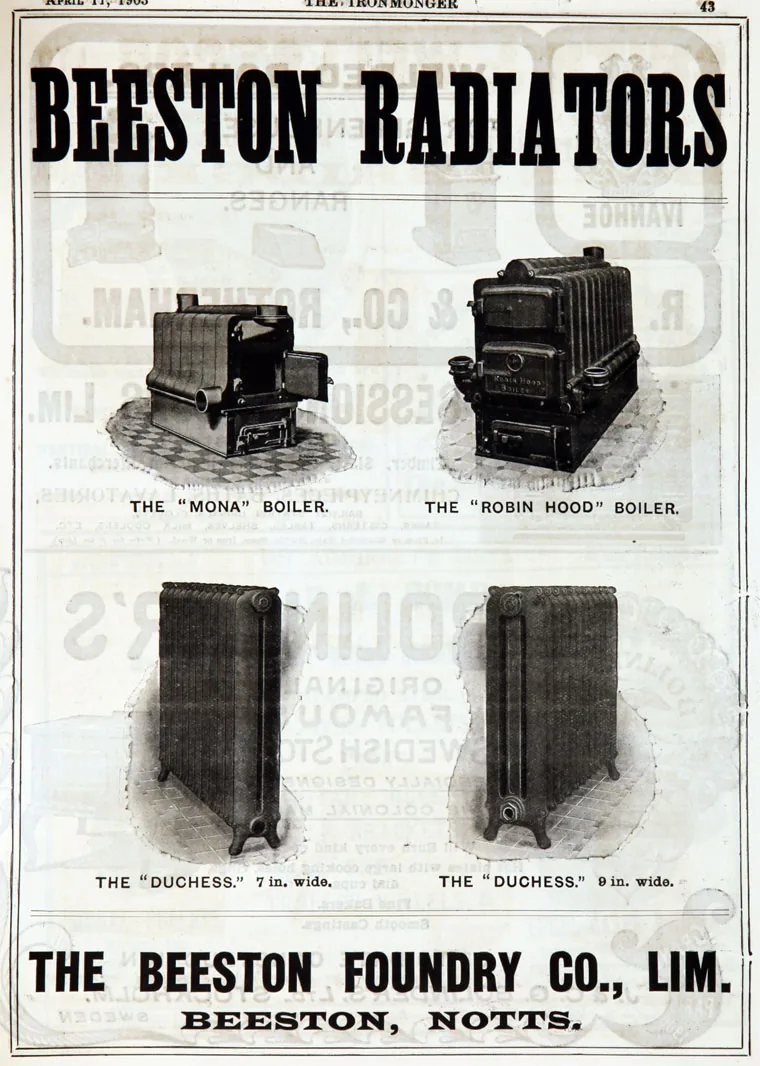
Beeston cast iron radiators were made by the Beeston Boiler Company (established as the Beeston Foundry Company on 10 April 1893 by brothers Henry and Louis Pearson) at its foundry in Beeston, Nottinghamshire — a firm that lasted until its receivership in 1976. To the reclamation trade its name stands for two things above all: the Princess, the plain round-topped radiator that warmed schools, libraries and public institutions across Britain, and the very term ‘school radiator’, which the trade traces to Beeston’s own 1936 catalogue.
A Nottinghamshire foundry, 1893 to 1976
The Beeston Foundry Company was established on 10 April 1893 in Beeston, Nottinghamshire, by brothers Henry John Pearson and Louis Frederick Pearson. It made its name in cast iron heating goods, above all the Robin Hood boiler, advertised by 1912 and the product the firm became famous for. In 1923 the firm was renamed The Beeston Boiler Company, and it kept growing: by 1961 it employed 850 people on a 28-acre site in the town. Like every British cast iron radiator maker, though, it was overtaken in the post-war decades as pressed steel panel radiators displaced cast iron in mass housing, and in 1976 the company went into receivership. The radiators outlived the foundry — by half a century so far, with no sign of stopping.
The Princess: Beeston’s signature radiator
The reclamation trade attributes the historic Princess to Beeston, and reproduces pages from the company’s 1914 catalogue showing the range — so the design was in Beeston’s hands no later than 1914. It is a plain, round-topped school-pattern radiator, its one flourish a slender bead running vertically down the front of each column. Restorers record it in one and two columns across five heights, and three columns across six heights, with a five-column version added in the 1920s, and it became a familiar fixture in schools, libraries and institutional buildings — exactly the market it was built for, where plain surfaces that were easy to keep clean mattered more than ornament.
The trade also records a charming line of period accessories for it: humidifying top rests, plug-in towel rails, and detachable curved baffles with decorative swirls that lent a touch of ornament to an otherwise austere design — some surviving radiators still carry them. In the 1930s the Princess was succeeded in Beeston’s range by the Royal School model.
How the ‘school radiator’ got its name
Britain’s schools, hospitals and public institutions were among the earliest and biggest adopters of central heating, and the plain, easy-clean pattern they specified eventually took the schools’ name. The term ‘school radiator’ is distinctly British — and the trade records its first use by a manufacturer in Beeston’s 1936 catalogue, which offered the Royal School as ‘a radiator with a plain surface, easily cleaned’. Other British foundries later made their own versions of the plain institutional pattern, but on the record as it stands, the name starts at Beeston. It is a small, satisfying footnote in the wider story of cast iron heating in Britain, which we tell in full in our history of cast iron radiators.
Identifying a genuine Beeston radiator
The reclamation trade records that Beeston typically cast the model family name into the radiator’s surface — a ‘Princess’ or ‘Royal School’ in the iron itself is the most reliable identifier there is. Restorers point to two further checks: pre-1930s Beeston designs have a bleed valve protruding from the top bush, a recognised Beeston trademark, and their legs are more bowed than the flared legs of National Radiator Company castings — whose Ideal Plain is otherwise the Princess’s nearest lookalike. The best moment to read any of this is when a radiator has been blasted back to bare iron during restoration: paint hides shallow casting marks, bare metal shows them plainly. It is one of the quiet pleasures of the work — a radiator’s identity surfacing with the old paint gone.
Beeston cast iron radiators at Radrestore
The Princess in our restored cast iron radiators range follows the classic Beeston pattern: round-topped, plain-surfaced, with the vertical bead down each column. We say ‘pattern’ deliberately. The Princess name has been reused more than once — the National Radiator Company also listed a Princess range in period, and reproduction makers sell newly cast ‘Princess’ radiators today — so we describe our radiators by pattern, and record a foundry only where the casting itself proves it. In the same spirit, Neo Classic School and Neo Classic Narrow School are Radrestore’s own range names for the school pattern — honest house naming, not a maker’s claim.
Every radiator we restore is covered by our 25-year Cast Iron Guarantee. If you are weighing up a Princess, or you think you may have a Beeston worth restoring, call us on 0161 843 8163 or reach us via the contact page — we’ll help you work out exactly what you’ve got.
Beeston cast iron radiators: FAQs
Who made the original Princess cast iron radiator?
The UK reclamation trade attributes the historic Princess to the Beeston Boiler Company of Nottinghamshire, and reproduces pages from Beeston’s 1914 catalogue showing the range. The name has been reused since, though — the National Radiator Company also listed a Princess range, and modern reproduction makers sell newly cast ‘Princess’ radiators today — so for any individual radiator, the name cast into the iron itself is the only certain answer.
How do I identify a genuine Beeston radiator?
The reclamation trade records that Beeston typically cast the model family name into the radiator’s surface — the most reliable identifier. Restorers also point to a bleed valve protruding from the top bush on pre-1930s Beeston designs, a recognised Beeston trademark, and legs that are more bowed than the flared legs of National Radiator Company castings. Casting marks read best once a radiator has been stripped back to bare iron during restoration.
Why are they called school radiators?
The term is distinctly British. The trade records its first use by a manufacturer in the Beeston Boiler Company’s 1936 catalogue, which offered the Royal School as ‘a radiator with a plain surface, easily cleaned’. Plain round-topped patterns like the Princess before it were specified for schools, libraries and hospitals precisely because they were easy to keep clean.
When did the Beeston Boiler Company close?
The company went into receivership in 1976, by which time pressed steel panel radiators had displaced cast iron across most of the British market. Its radiators survive in large numbers, and a properly restored example goes back into service with decades of working life ahead of it.
Sources: Grace’s Guide to British Industrial History; Wikipedia (Beeston Boiler Company); Beeston catalogue pages of 1914 and 1936 as reproduced in the UK reclamation trade; salvage-trade records of surviving examples.