


Crane Ltd · Ipswich works · “Boilers, Radiators, Valves & Fittings”
Crane cast iron radiators were made by Crane Ltd at its Nacton Road works in Ipswich, where cast iron radiator manufacture began in the early 1930s. The Crane name itself is far older — a Chicago foundry founded in 1855 that grew into one of the world’s great engineering firms. This page tells the story of the company behind the castings, and shows how a genuine Crane is identified today.
From a Chicago brass foundry to a world name
Richard Teller Crane opened the R.T. Crane Brass & Bell Foundry in Chicago in 1855 — the company dated its founding to 4 July that year. Early contracts included pipe and steam-heating equipment for large public buildings, among them the Cook County courthouse and the state prison at Joliet. The business was renamed Crane Co. in 1890, by which time it had grown into one of America’s largest makers of valves, fittings, plumbing and heating equipment.
Crane comes to Britain
Crane’s British story begins with James E. Bennett & Son Ltd, a London firm of coppersmiths established in 1908. Crane Co. bought the business in 1919 and renamed it Crane-Bennett Ltd; the same year it bought around 40 acres of heathland on Nacton Road, Ipswich, for a foundry of its own. The foundation stone was laid in February 1921, and the first metal was poured in the malleable iron foundry in 1927 — an anniversary the works thought enough of to mark, fifty years on, with a commemorative garden. In 1932 Crane-Bennett Ltd became Crane Ltd, the name the British business carried from then on.
Radiators from the Ipswich works
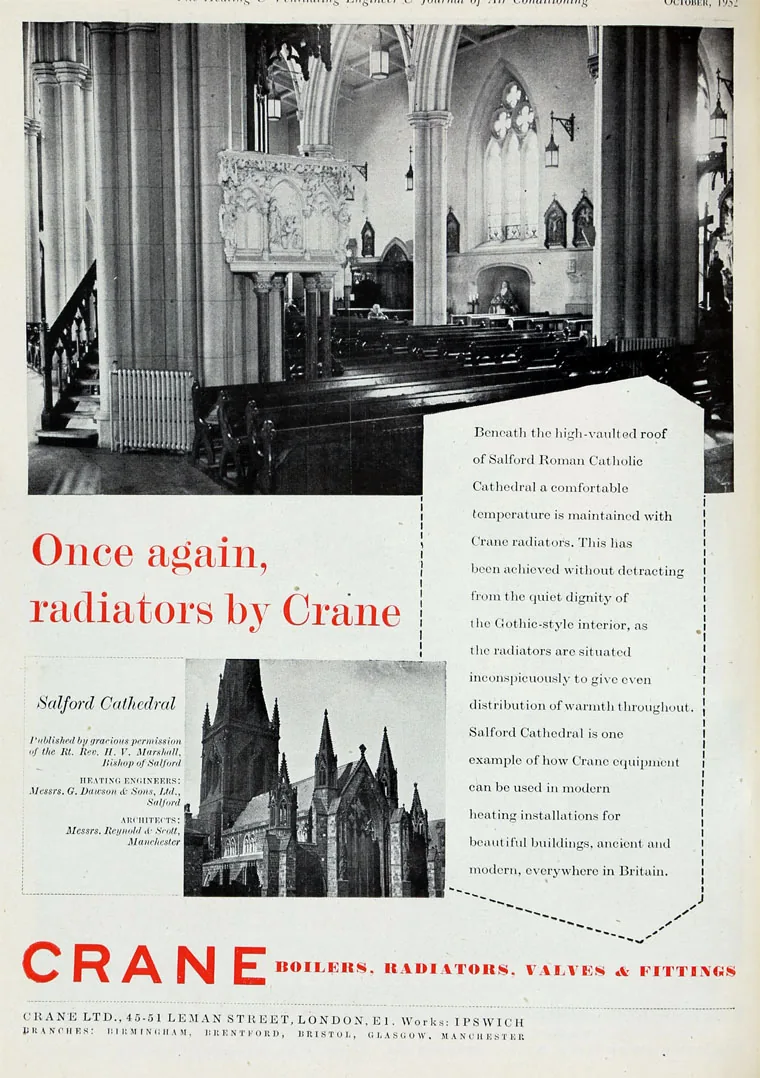
Cast iron radiator, boiler and valve manufacture began at Ipswich in the early 1930s, and it is from this point that the Crane radiators found in British buildings date. Column radiators of this kind were common equipment in the schools, hospitals, churches and other public buildings of the period, and the UK reclamation trade still recovers much of its overall stock from buildings like these.
The works turned to war production in the 1940s — parts for trucks, tanks, machine guns and munitions — then expanded again after 1946. By the 1970s Crane was Ipswich’s largest manufacturing employer, with around 3,000 workers and the largest private rail sidings in East Anglia. At its peak the works produced heating boilers and radiators in large numbers alongside hundreds of thousands of valves and fittings, even as pressed steel panels displaced cast iron across the wider British market. The exact year radiator production ended at Ipswich is not recorded in accessible sources. For the wider story of how cast iron rose and fell in Britain, see our history of cast iron radiators.
The end of the foundry
The Ipswich foundry closed in 2008, when production moved abroad, ending more than eighty years of casting on the site. The works was cleared in 2011 and 2012 and the land is now a retail park; a road on the redeveloped site, James Bennett Avenue, remembers the engineer whose London firm began Crane’s British story. The valves and fittings side of the business survives as Crane Fluid Systems — but it makes no radiators. Every genuine Crane cast iron radiator is therefore an antique original from the Ipswich era: it can be reclaimed and restored, but never replaced.
Identifying a genuine Crane radiator
The reclamation trade identifies Crane castings by three marks. The most reliable is the name itself: CRANE cast or stamped on top of an end section, above the bush. Bush ends often carry a second mark — a diamond enclosing a letter C — though restorers treat this one with caution, because bushes can be swapped between radiators and a Crane bush only proves where the bush came from. The third tell is in the legs: Crane legs show a slight inward bow at mid-leg, where National Radiator Company castings have fully flared legs.
All three read most clearly on bare metal. Stripping a radiator back to bare iron is the first stage of our restoration process, and it is the moment a casting mark that has spent decades under paint becomes legible again.
Crane cast iron radiators at Radrestore
Our ready-to-ship range includes restored Crane radiators as stock allows — radiators that carry the Crane name, restored in our Stockport workshop and ready to go. Crane originals also appear among our restored cast iron radiators as stock comes through the workshop, alongside the other great British makers. Every restored radiator we sell is covered by our 25-year Cast Iron Guarantee.
If you already own a Crane radiator — or a radiator you suspect is one — our restoration service will strip it back, repair it, pressure-test it and finish it to your specification, and we will tell you what the bare iron reveals about its maker. Call 0161 843 8163 or get in touch via our contact page.
Crane cast iron radiators: FAQs
When were Crane cast iron radiators made?
Crane Ltd began casting iron radiators at its Nacton Road works in Ipswich in the early 1930s. The exact year radiator production ended is not recorded in accessible sources; the Ipswich foundry itself closed in 2008.
How can I tell if a radiator is a genuine Crane?
The reclamation trade looks for the word CRANE cast or stamped on top of an end section, above the bush. Bush ends often carry a diamond enclosing a letter C, though that mark alone is not definitive — bushes can be swapped between radiators. Crane legs also show a slight inward bow at mid-leg, where National Radiator Company castings have fully flared legs. All of these read most clearly once the radiator has been stripped back to bare iron during restoration.
Are original Crane cast iron radiators still made?
No. The historic Crane Ltd foundry at Ipswich closed in 2008, and the Crane valves business that survives makes no radiators. Every original Crane cast iron radiator is an antique — reclaimed and restored, not newly manufactured.
Does Radrestore sell restored Crane radiators?
Yes. Our ready-to-ship range includes restored Crane radiators as stock allows, and Crane originals appear among our restored cast iron radiators as stock comes through the workshop. Every restored radiator we sell is covered by our 25-year Cast Iron Guarantee — call 0161 843 8163 if you are looking for something specific.
Sources: Grace’s Guide to British Industrial History; Suffolk Heritage Explorer (Suffolk County Council); Ipswich Historic Lettering; Crane company records (Crane Building Services & Utilities history); Made in Chicago Museum; East Anglian Daily Times archive reporting. Identification details are as recorded by the UK reclamation trade.